
The cybersecurity landscape has fundamentally changed. For years, defenders could manage by simply adding more rules, analysts, and tools, but that static approach is now falling apart. Artificial intelligence has not just introduced a new threat; it has fundamentally altered the landscape of network security, giving attackers an asymmetric edge.
Today, both state-sponsored and criminal groups leverage AI to automate reconnaissance, tailor social engineering tactics, and rapidly weaponize vulnerabilities much faster than traditional defenses can handle. We're seeing a notable uptick in AI-enhanced activities, leading to a worrying rise in incident complexity and severity across critical sectors such as public administration and healthcare.
The fundamental weakness is evident: AI has made complex attacks quick and cheap, pushing the speed of the attacker's process (probe → learn → adapt) beyond the defender's ability to respond. Legacy systems, built on static controls like signature-based detection and static allow/deny lists, are failing because they assume past behavior predicts future attacks.
This creates a massive market opportunity. To survive in this fast-paced environment, the question is no longer "Will AI impact cybersecurity?"—it already is. The real concern is whether defenders can adapt their architectures and mindsets quickly enough. The next generation of security must be architected for adaptive speed, built to look beyond the operating system, and treat machine learning systems as both a critical asset and a target. This new operational model is the foundation of our solution.
1. AI Has Made Attacks Quick and Cheap
In the past, launching complex attacks took significant skill and time. Now, AI has made it possible to lower both of those barriers:
• Automated malware evolution: Studies show reinforcement-learning models can train against specific security systems and produce variants that can slip by detection after just a few months of adjustments.
• Adversarial machine learning: Models can be manipulated throughout their lifecycle—from data collection to inference—seriously undermining AI defenses.
• Tailored social engineering: Generative AI is expected to blur the lines between phishing and legitimate emails, leading to more frequent and successful scams.
While defenders have to justify every dollar they spend, attackers can easily scale and experiment using open-source models, cheap cloud services, and leaked tools.
2. The Defender’s Main Weakness: Static Controls vs. Adaptive Attacks
Many businesses still depend on controls that assume past behavior is a good predictor of future attacks:
• Signature-based detection
• Static allow/deny lists
• Periodical threat intelligence updates
On the flip side, AI-boosted attackers can:
• Continuously change their payloads: They generate slightly modified binaries, scripts, or URLs and test these against existing defenses, keeping the ones that bypass them.
• Exploit weaknesses across platforms: Different environments (like Windows, Linux, macOS, and OT) give attackers multiple ways to maintain access.
• Target the defender’s AI: Tactics like data poisoning, model inversion, and creating adversarial examples can undermine the machine learning models used in security operations.
In simple terms, the attacker's process (probe → learn → adapt) is now outpacing the defender's ability to change and deploy new strategies.
3. New AI-Driven Threats Challenge Old Thinking
Defenders now need to protect not just endpoints and networks, but also models, data pipelines, and trust systems.
• 3.1 Data Poisoning and Model Integrity: Attackers can inject crafted data into telemetry streams (logs, alerts, user behavior) to create blind spots in the models that defend the network. Poisoned training and feedback loops are significant emerging attack strategies.
• 3.2 AI-Generated Content and Identity Attacks: Attackers utilize generative models to create deepfake voices and faces, fake social media profiles, and hyper-personalized phishing messages that mimic the writing styles of targets.
• 3.3 AI-Assisted Vulnerability Discovery: Large language models and specialized AI tools can help attackers sift through codebases and misconfigurations much faster than they could manually.
4. Why Classic “Layered Defense” Falls Short
While “defense in depth” is still needed, it’s increasingly insufficient because most defense layers share common, systemic vulnerabilities:
• They depend on timely and accurate threat intelligence and signatures.
• They function primarily at the application or OS levels, not underneath.
• They assume the defender's machine learning models are reliable and free from poisoning.
As AI-powered attackers evolve rapidly, these common assumptions create systemic risks. Even as adversaries test advanced AI techniques, critical sectors are still struggling with basic measures such as patching and segmentation. In essence, we've built a multi-layer defense, but we're still operating under outdated assumptions about how attackers breach it. This requires a shift to architectural high ground and machine learning integrity.
5. What Defenders Need in the Age of AI
To survive in this fast-paced environment, defenders need more than just new tools.
5.1 Defensive Systems Must Embrace AI
AI is now integral to both attack and defense. Defenders should:
• Treat models as critical assets: Use threat modeling, red teaming, and robust security measures specifically for machine learning systems, following new standards on adversarial ML.
• Keep an eye on data pipelines: Watch for unusual patterns in training and feedback data that might signal poisoning attempts.
• Adopt a “trust but verify” mindset: Human analysts must understand how AI-driven detections and suppressions happen, especially for high-stakes actions.
5.2 Look Beyond the OS and Focus on Persistence Paths
One of the biggest advantages defenders can strive for is architectural high ground. This means keeping tabs on the areas attackers need to access for persistence, no matter how their payloads evolve.
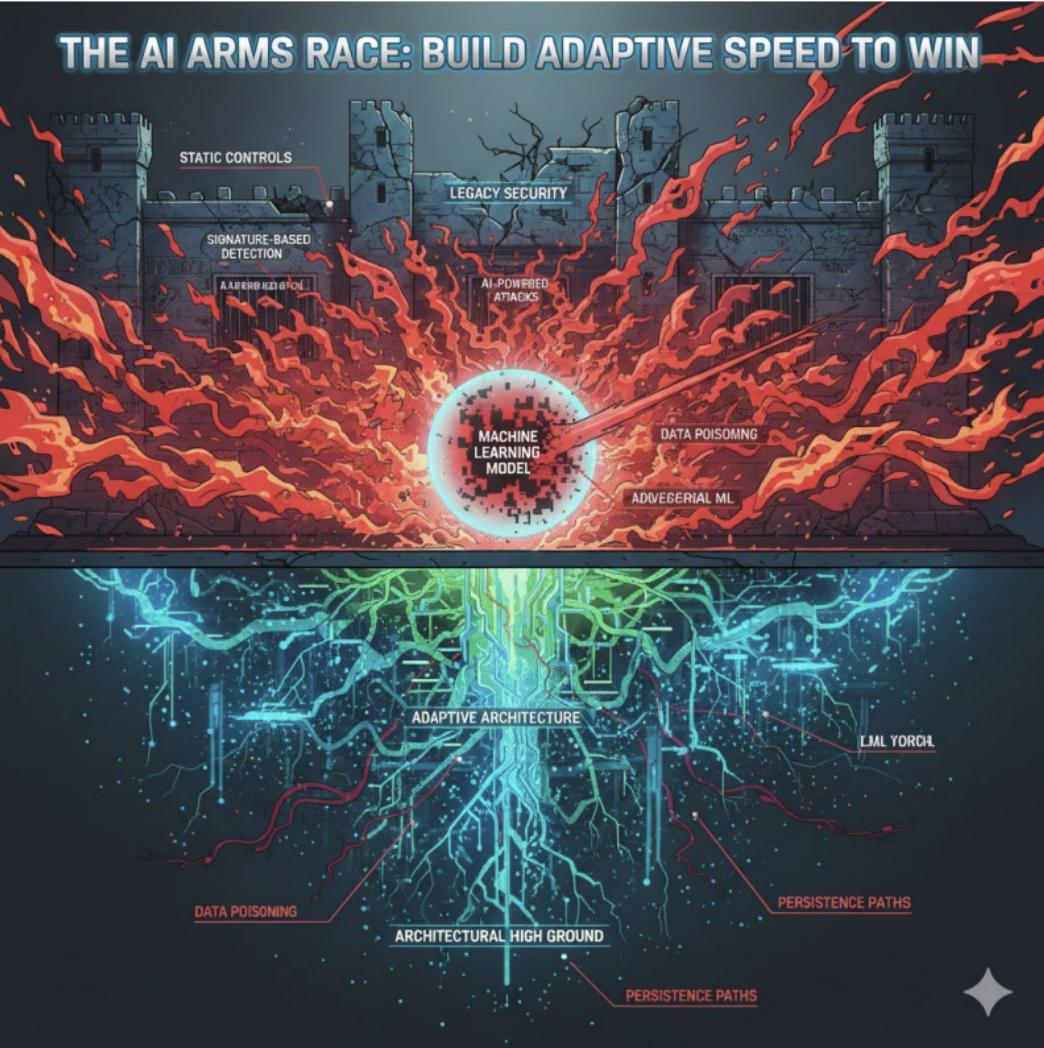
This involves:
• Monitoring registry entries, services, boot loaders, and components near the kernel—not just files and processes.
• Treating any changes in persistence as major security incidents.
• Using controlled randomness in defensive measures to prevent attackers from locking on to a single target.
This approach doesn’t matter whether the adversary’s malware was manually crafted or AI-generated; if it wants to stick around, it has to cross a monitored checkpoint.
5.3 Design for a Diverse Environment
AI-powered attackers are good at finding gaps between platforms. Defenders need controls that ensure Consistent Coverage across mixed environments:
• Work across Windows, Linux, macOS, and cloud-native applications.
• Normalize data across different operating systems.
• Avoid fragile, single-OS assumptions in detection and response.
Strong cross-platform detection and adaptability help maintain consistent controls and coverage.
5.4 Close the Human Loop
AI isn’t a magic bullet; it speeds things up for both sides. Effective defense today calls for:
• Training analysts in adversarial machine learning principles so they can spot manipulation attempts.
• Restructuring SOC workflows so that humans can focus on deeper investigations and proactive hunting while AI handles initial triage and noise reduction.
• Integrating threat intelligence and research closely with product teams, making sure insights into how attackers use AI lead quickly to defensive updates.
6. A New Operational Model for Security Teams
For innovators and the founders behind the next wave of security firms, the takeaway is straightforward: thriving in an AI-driven threat landscape requires a new operational model, not just new buzzwords on a slide.
This is the strategic thesis:
• Attackers are already using AI: Every defensive measure must assume AI-boosted attacks from the start.
• Architecture is the Battleground: Defensive architectures must be adaptive, aware of underlying OS details, and designed for cross-platform use.
• ML is Both Tool and Target: Protecting machine learning systems is as important as leveraging them.
• Speed is the Differentiator: The ability to learn from attacks, update policies, and automatically adjust defenses is the crucial security attribute.
We're entering a time where the question isn't “Will AI impact cybersecurity?”—it's already doing so. The real concern is whether defenders can adapt their architectures and mindsets quickly enough to keep pace with attackers who have moved beyond relying solely on human speed. This new operational model is the foundation of our solution.
By Nicholas Phillips, Founder of MDI Secure